
Jin, Z., & Webb, S. (2025). To what extent does reviewing notes affect L2 vocabulary learning? Applied Linguistics, 1–21.
The present study investigated the extent to which reviewing notes, after viewing an academic lecture, contributes to vocabulary learning. A total of 128 Chinese university students were randomly assigned into five groups: conventional note-taking with immediate review, conventional note-taking with delayed review, guided note-taking with immediate review, guided note-taking with delayed review, and a control group. Knowledge of twenty-eight words encountered in the lecture was measured. A counterbalanced form-recall and meaning-recall test was used through pretest, posttest, and delayed posttest. Results showed that (1) immediately after the treatment, taking guided notes played a larger role in vocabulary learning over reviewing notes on both form- and meaning-recall tests; in contrast, conventional note-taking appears to depend more on reviewing notes for form-recall but not meaning-recall, (2) reviewing notes after an interval in guided note-taking contributed to significant vocabulary gains on the form-recall test. Additionally, the analyses revealed that writing unknown words, learners’ comprehension levels, and their prior vocabulary knowledge had a significant impact on learning. However, review schedule, frequency of occurrence, target words presented in guided notes, and target words shown in slides did not significantly influence learning.

By |2026-01-12T15:35:38+08:00January 12, 2026|research highlight|Comments Off on Jin, Z., & Webb, S. (2025). To what extent does reviewing notes affect L2 vocabulary learning? Applied Linguistics, 1–21.

Yuan, R., Wang, Z., & Liu, S. (2023). When big ideas meet critical thinking in lesson study: Insights from a pre-service language teacher education course. Language Teaching Research, 13621688231211664.

This article reports a classroom-based inquiry in which a group of pre-service language teachers were guided to engage in a lesson study project focusing on the incorporation of the framework of big ideas into language teaching. Specifically, the study zooms in on the student teachers’ exercise and development of critical thinking (CT) through the lesson study process. Relying on data from semi-structured interviews and classroom artifacts, the findings reveal that the introduction of big ideas in lesson study served as a crucial knowledge base for the participants’ pedagogical sensemaking, thus contributing to their CT. The process of lesson study, characterized by a progressive structure, tailored scaffolding, and constructive feedback, also facilitated their development of CT skills and dispositions, which in turn contributed to their understanding and application of the big idea framework within the lesson study process. While the participants encountered some negative feelings in the process (e.g. due to the competitive atmosphere brought by the ‘same topic and different design’ arrangement), they tried to turn such emotions into a stimulating source for their CT growth and professional learning. In light of the research results, pedagogical implications for teaching and teacher education were put forward in the end.

By |2026-01-12T15:33:17+08:00January 12, 2026|research highlight|Comments Off on Yuan, R., Wang, Z., & Liu, S. (2023). When big ideas meet critical thinking in lesson study: Insights from a pre-service language teacher education course. Language Teaching Research, 13621688231211664.

Gong, Y., & Gao, X. (2024). Language teachers’ identity tensions and professional practice in intercultural teaching. Language Teaching Research, 13621688241241125.

Language teachers’ experiences of identity tensions present valuable opportunities for researchers to understand the complex role of professional identity in shaping language teachers’ instructional practice. This exploratory sequential mixed-method study reports on identity tensions as experienced by teachers of Chinese as an additional language (CAL), and its role in mediating their instructional practice in intercultural teaching. First, seven types of professional and sociocultural identities related to intercultural teaching were generated based on interview responses and observation field notes from 10 CAL teachers. One hundred and three CAL teachers were then surveyed to identify the roles of these identities in mediating their approaches to intercultural teaching. An exploratory factor analysis of the survey data suggested that cultural learner identity, cultural bridge identity, and bearer of Chinese culture identity were significant predictors of fact-oriented or holistic development-oriented approaches to intercultural teaching. Furthermore, it was found that the tension and synergy among different identity components coexisted in mediating the participants’ efforts in intercultural teaching. The findings underscore the importance of adopting identity-oriented perspectives and approaches, and paying more attention to teacher identity tensions in supporting language teachers’ professional practice and development.

By |2026-01-12T15:30:57+08:00January 12, 2026|research highlight|Comments Off on Gong, Y., & Gao, X. (2024). Language teachers’ identity tensions and professional practice in intercultural teaching. Language Teaching Research, 13621688241241125.

Wang, K., Yuan, R., & De Costa, P. I. (2025). A critical review of English medium instruction (EMI) teacher development in higher education: From 2018 to 2022. Language Teaching.

The past few years have witnessed an emergent growth of both academic and practical works on English medium instruction (EMI) teachers’ professional development. This paper presents a critical analysis of 30 empirical studies on EMI teacher development in a wide range of higher educational settings from 2018 to 2022. Through a systematic process of paper selection and review, we have identified three general routes to EMI teacher development, namely: (1) formal training activities; (2) opportunities for teacher collaboration; and (3) self-initiated practices. For each route, we presented a critical appraisal of their design and implementation, as well as reported gains and challenges. Meanwhile, we also conducted a critical analysis of the methodological issues pertaining to the selected papers. Overall, we argue that EMI teacher development in higher education is largely construed as a hybrid, contested, and transformative enterprise featured by EMI teachers’ constant boundary-crossing at different levels to seek professional growth in linguistic, pedagogical, cultural, and psychological domains. During this process, EMI teachers may encounter conflicted dispositions, power asymmetries, and individual contradictions. Such a process thus requires EMI teachers to rethink, reexamine, and reflect critically on their accustomed preconceptions and practices, in order to facilitate transformation and achieve sustainability in the long run. The review also presents implications for EMI teachers, teacher educators, policymakers, and researchers on effectively facilitating EMI teacher development in higher education.

By |2026-01-12T15:29:15+08:00January 12, 2026|research highlight|Comments Off on Wang, K., Yuan, R., & De Costa, P. I. (2025). A critical review of English medium instruction (EMI) teacher development in higher education: From 2018 to 2022. Language Teaching.

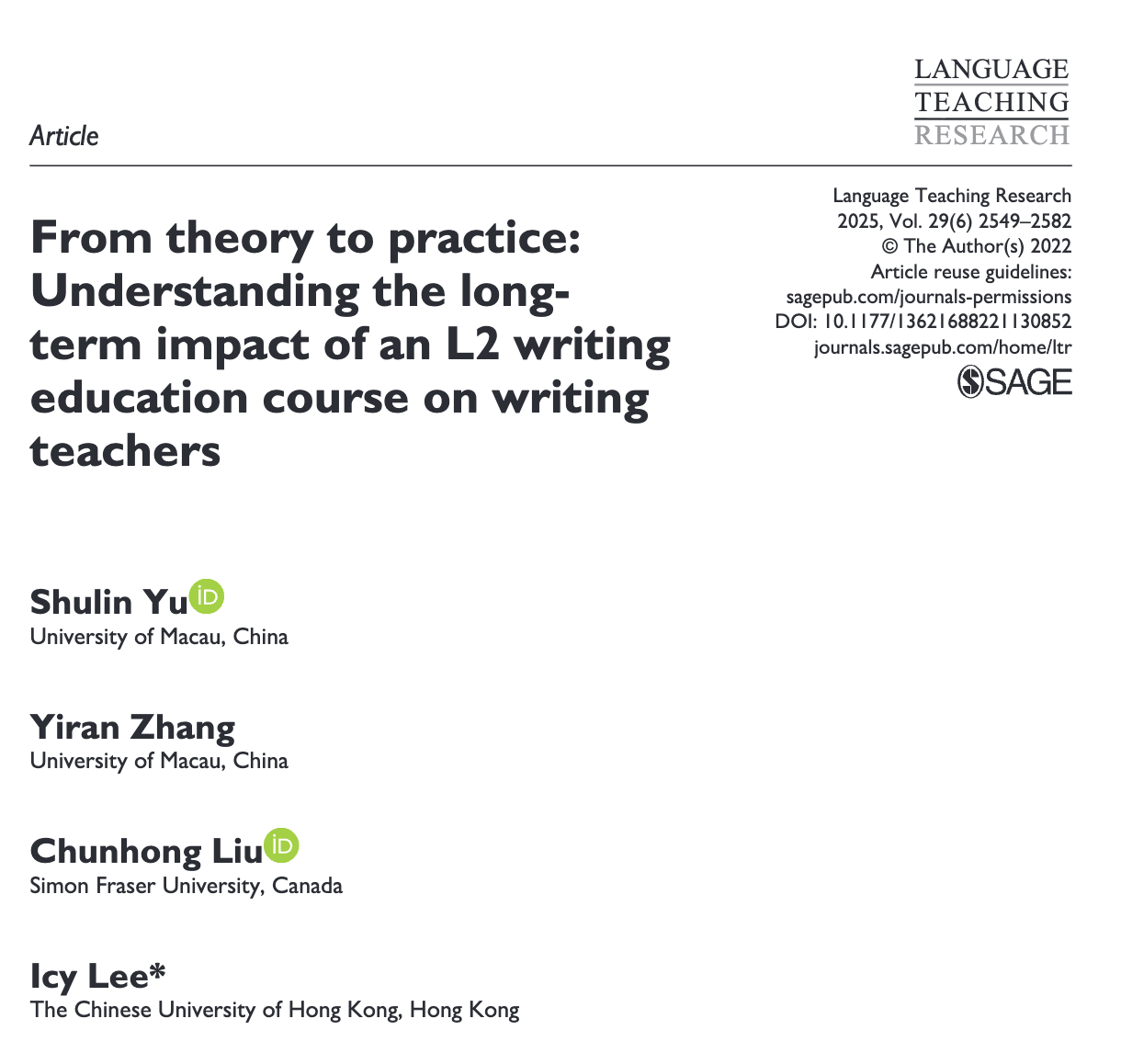
Yu, S*., Zhang, Y., Liu, C., & Lee, I. (2022). From theory to practice: Understanding the long-term impact of an L2 writing education course on writing teachers. Language Teaching Research.

Research on second language (L2) writing tends to focus much more on student learning of writing than teachers’ teaching and learning of the teaching of writing. While a few studies have considered the influence of formal education on teachers’ L2 writing instruction, such as by examining the changes in teacher beliefs and practices across one semester (Lee, 2010), little is known about the long-term impact (e.g., 2 or 3 years) of such training on the professional development of L2 writing teachers. The present study adopted a multiple-case study approach to examine the long-term effects of a course on teaching L2 writing on five teachers of writing who taught writing in different contexts (primary school, secondary school, private language training center, and university) in the Chinese EFL context and how the teachers may apply the theoretical knowledge and recommended pedagogies presented in such a course. Drawing upon multiple sources of data, including interviews, stimulated recalls, and teaching materials, this study revealed that despite the peripheral position of writing in current L2 literacy education, training teachers to teach L2 writing can have both immediate and lasting effects on their thinking, practices, and learning as L2 writing teachers. The course enhanced the teachers’ understanding of L2 writing and writing instruction and enabled them to adopt new pedagogies and feedback practices, whereas previously they had neglected writing instruction and taught writing based on their prior learning experiences. However, the teachers’ teaching experience determined their appropriation of the new pedagogies when contextual constraints such as students’ language proficiency, limited class hours, and exam pressure hindered their adoption of the changes. The study draws attention to L2 teachers’ knowledge gaps (thinking), their teaching practices, and their learning to teach writing (learning) and elucidates the impact of educating language teachers to teach writing across various educational settings.

By |2025-12-29T12:48:12+08:00December 29, 2025|research highlight|Comments Off on Yu, S*., Zhang, Y., Liu, C., & Lee, I. (2022). From theory to practice: Understanding the long-term impact of an L2 writing education course on writing teachers. Language Teaching Research.

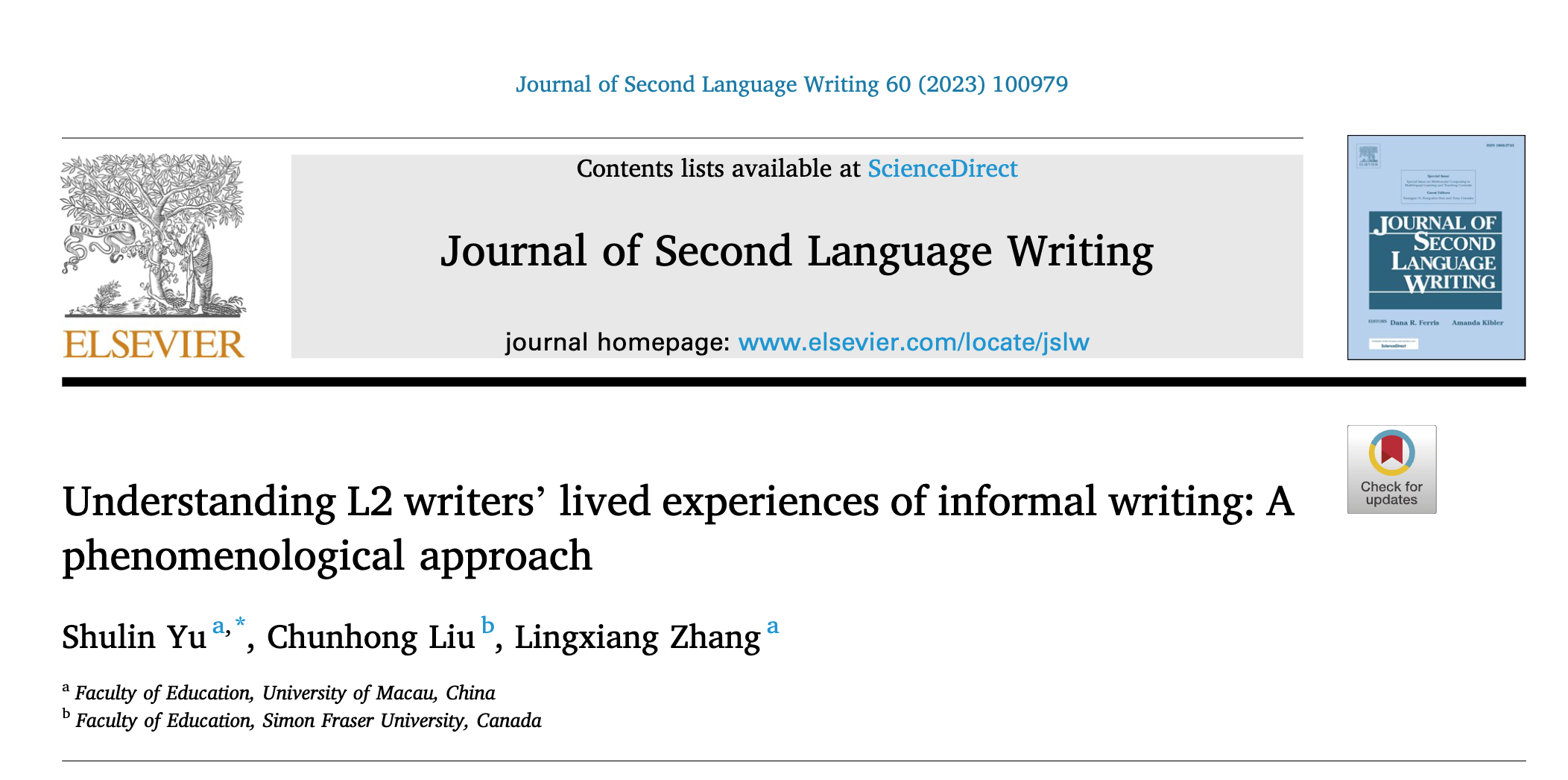
Yu, S.*, Liu, C., & Zhang, L. (2023). Understanding L2 writers’ lived experiences of informal writing: A phenomenological approach. Journal of Second Language Writing, 60, 100979.

While much attention has been directed at formal or academic writing in teaching and researching second language (L2) writing, informal writing still holds a marginal position in the current writing research, suggesting a neglect of its value as teachable in schools and meaningful for personal development. Adopting a phenomenological approach, the present study investigates L2 university student writers’ perceptions of and experience with informal writing both in and out of the classroom context. Drawing upon semi-structured individual interviews and written arti-facts, this study revealed five themes pertaining to student writers’ experiences of informal L2 writing and demonstrated its learning potential as playground, situated interaction, and learning strategy. This study has implications for L2 writing scholarship with its situated and nuanced understanding of L2 student writers’ experiences of and engagement with informal writing. It also discusses the imperative for a refined understanding of L2 informal writing instruction and curriculum design.

By |2025-12-29T12:46:39+08:00December 29, 2025|research highlight|Comments Off on Yu, S.*, Liu, C., & Zhang, L. (2023). Understanding L2 writers’ lived experiences of informal writing: A phenomenological approach. Journal of Second Language Writing, 60, 100979.

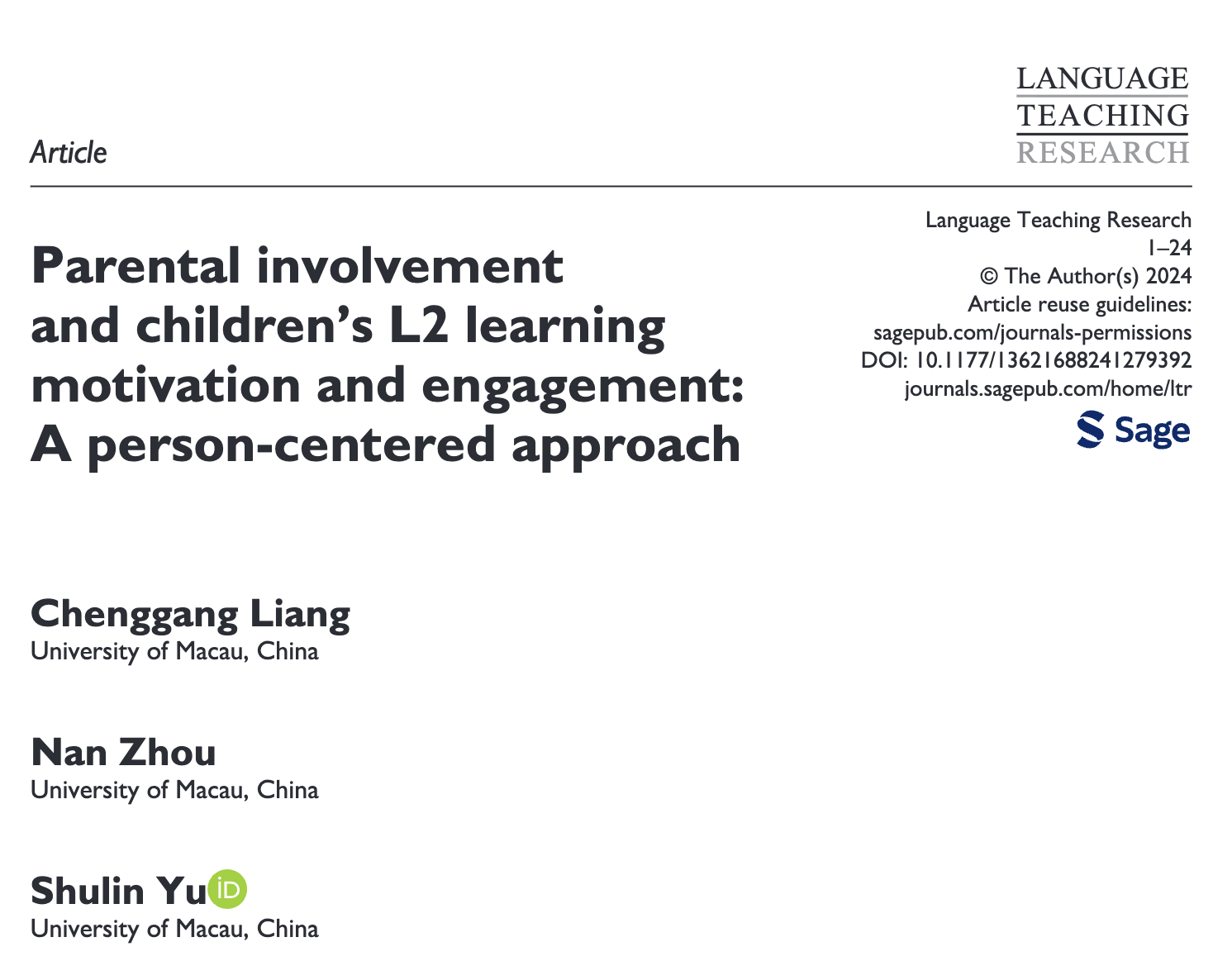
Liang, C., Zhou, N., & Yu, S.* (2024). Parental involvement and children’s L2 learning motivation and engagement: A person-centered approach. Language Teaching Research, 13621688241279392.

Research has consistently demonstrated that parental involvement plays a key role in children’s early second language (L2) development. However, little is known about how different aspects of parental involvement in children’s L2 learning are configured and how these differentiated combinations of parental involvement are associated with children’s L2 motivation and engagement. Moving beyond prior studies, which typically focused on the effects of single aspects of parental involvement, this study utilized a person-centered approach to examine the configuration patterns of various indicators of parental involvement in children’s L2 learning (i.e. parental autonomy support, psychological control, and behavioral control). Data were collected from a sample of 702 seventh graders (Mage = 13.09, SD = 1.64; 50.14% girls) in two major cities in China. Four distinct profiles (i.e. Authoritative, Neglectful, Control-centered, and Intrusive) were identified. Children’s L2 learning motivation and engagement varied across these profiles. These more nuanced findings shed light upon the heterogeneous nature of various parental involvement in children’s L2 learning and carry significant practical implications for both parents and practitioners aiming to foster a more supportive environment for children’s L2 learning.

By |2025-12-29T12:44:29+08:00December 29, 2025|research highlight|Comments Off on Liang, C., Zhou, N., & Yu, S.* (2024). Parental involvement and children’s L2 learning motivation and engagement: A person-centered approach. Language Teaching Research, 13621688241279392.

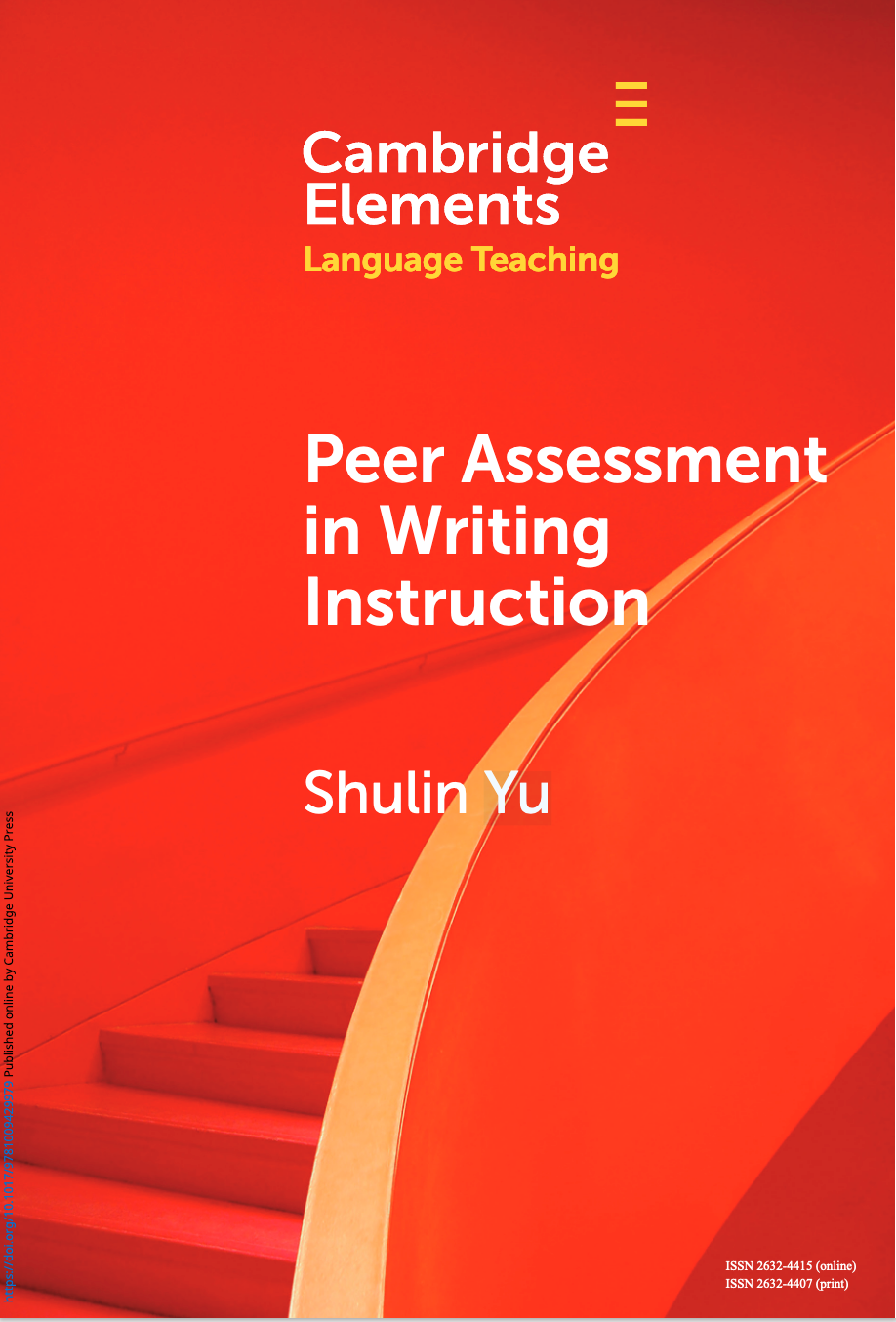
Yu, S. (2024). Peer Assessment in Writing Instruction. Cambridge University Press.

This Element traces the evolution of peer assessment in writing instruction and illustrates how peer assessment can be used to promote the teaching and learning of writing in various sociocultural and educational contexts. Specifically, this Element aims to present a critical discussion of the major themes and research findings in the existing studies on peer assessment regarding the three assessment paradigms (assessment of, for, and as learning), and to identify whether and how peer assessment has served the purposes of assessment of, for, and as learning, respectively in writing instruction. This Element highlights the contextual factors that shape the effect of peer assessment in writing instruction and concludes with directions for future research and implications regarding how peer assessment can be successfully used to improve students’ writing development.

By |2025-12-29T12:34:17+08:00December 29, 2025|research highlight|Comments Off on Yu, S. (2024). Peer Assessment in Writing Instruction. Cambridge University Press.

Yu, S., Zhang, E. D., & Liu, C. (2024). Research into practice: Digital multimodal composition in L2 writing. Language Teaching, 1-17.

Digital multimodal composing (DMC) has been valued as an engaging pedagogy in language teaching and learning in recent decades. Although research on DMC is flourishing and evidences its benefits for students’ development as second language (L2) users and writers, there are some missing links between research findings and classroom practices. In this article, we examine three kinds of relationships between research and practice with regard to DMC: areas in which research findings have not been well applied, areas in which research findings have been reasonably well applied, and areas in which research findings have been usefully applied. As recent research–practice frameworks in education research emphasize a collaborative relationship between researchers and practitioners, we argue that L2 writing researchers’ and teacher educators’ reflections and experiences are crucial to facilitate the dialogue between DMC research and practice in writing contexts. We suggest that DMC should be incorporated into L2 teacher education programs so that instructors are equipped with the necessary knowledge and competence to design, implement, and assess students’ DMC productions.

By |2025-12-29T12:40:23+08:00December 29, 2025|research highlight|Comments Off on Yu, S., Zhang, E. D., & Liu, C. (2024). Research into practice: Digital multimodal composition in L2 writing. Language Teaching, 1-17.

Hsiang, T. P., Graham, S., Lin, C., Wang, C., & Cao, Y. (2025). Teachers’ perceptions of their students’ digital citizenship and practices. Elementary School Journal, 126(1), 138-168.

Abstract

Because digital devices are central to everyday life, students need to become good digital citizens. In this study, 646 Grades 4–9 Chinese language arts teachers (85.2% were female), randomly selected from schools in Chongqing China, completed a survey about teaching digital citizenship and students’ digital citizenship capabilities. Four out of every five teachers taught digital citizenship, and they were slightly positive about students’ digital

citizenship capabilities. Teaching digital citizenship was predicted by preparation to teach these skills, teacher certification, teachers’ digital capabilities, time spent online at school, frequency of internet use at home, and perceived benefits of internet use. Teachers’ judgments of students’ digital citizenship capabilities were predicted by preparation to teach these skills, frequency of internet use at home, and perceived benefits of internet use.

Teachers’ judgments about students’ digital citizenship capabilities predicted students’ own assessments of these skills. Implications for practice and future research are presented.

Contributions of this paper

The study of teachers’ perceptions of their students’ digital citizenship is limited to a study conducted in the U.S., which found that middle school teachers did not believe their students had developed good digital citizenship practices (Martin et al., 2019). More research attention has been devoted to asking students to rate their digital citizenship capabilities. Students generally agree they follow the social norms of digital citizenship, but this is not the case for all students and for all aspects of this construct (e.g., cyberbullying, sharing passwords with others, befriending strangers, and using false information to register online). No study to date has examined the relationship between teachers’ and students’ perceptions of students’ digital citizenship.

The present investigation expands on the Martin et al. (2019) study in six important ways. This is the only prior study examining teachers’ perceptions of students’ digital citizenship capabilities. First, the Grades 4 to 9 Chinese language arts teachers in this study were randomly selected from all of the public and private schools in the Chongqing municipality in China (Martin et al involved a convenience sample). Second, we asked teachers to assess their students’ capabilities by applying two additional aspects of digital citizenship: balanced media use and media literacy. Third, we established the factor structure and reliability of the various measures applied in this study. Martin et al. (2019) did not examine the psychometric properties of their instruments. Fourth, we applied a more expansive set of predictors to examine factors that accounted for the variance in teachers’ judgments about their students’ digital citizenship capabilities. This included teachers’ preparation to teach digital citizenship, how frequently teachers used digital devices for learning and recreation, and their beliefs about the benefits of online engagement. Fifth, we also examined factors that predicted reported teaching of digital citizenship by teachers (this was not done in Martin et al., 2019). This included the four constructs used to predict teachers’ beliefs about their students’ digital citizenship capabilities identified above as well as time spent online at school, teachers’ perceptions of their capabilities to use digital tools, and teacher certification.

The sixth way in which this study differed from Martin et al. (2019) is that we examined if teachers’ perceptions of students’ digital capabilities predicted students’ assessments of their own capabilities. We were unable to locate any study that had examined this issue previously. If teachers’ estimates are a strong predictor of students’ estimates of their digital citizenship capabilities, then this provides some empirical support for the use of teachers’ judgments as a means for determining what should be taught.

The present study found that most of the participating teachers taught digital citizenship to their students, and both teachers and students were positive about students’ digital citizenship capabilities. However, teachers’ judgements of students’ capabilities were not a strong predictor of students’ own estimates. Based on both teacher and students’ judgements, there is room for students to develop even stronger digital citizenship skills. Further, if teachers’ judgements are to serve formative assessment purposes, they need to be supplemented by other forms of evidence because the accuracy of teachers’ judgments of students’ digital citizenship skills are unknown.

Findings from this study are important because students need to learn how to act online in safe, responsible, healthy, and ethical ways. With the advent of artificial intelligence (AI), this has become even more critical. We think the concept of digital citizenship needs to be expanded to include AI (Hsiang et al., in press), and both parents, children, and teachers will need guidance on the kinds of socially desirable behaviors that children need to acquire in an AI world. 


Journal

Elementary School Journal

The University of Chicago

ISSN: 0013-5984

E-ISSN: 1554-8279

5-year Journal Impact Factor: 1.5

2024 JCR Impact Factor*: 1.4

Ranked #326 out of 756 “Education & Educational Research” journals [Q2]

The Elementary School Journal has served researchers, teacher educators, and practitioners in the elementary and middle school education for more than one hundred years. ESJ publishes peer-reviewed articles that pertain to both education theory and research and their implications for teaching practice. In addition, ESJ presents articles that relate the latest research in child development, cognitive psychology, and sociology to school learning and teaching.

First published in 1900 as The Course of Study, the title was changed to The Elementary School Teacher and Course of Study in 1901. The title was changed to The Elementary School Teacher in 1902, and to The Elementary School Journal in 1914.

Link

https://doi.org/10.1086/736603

AERA i-Presentation Gallery: https://aera25-aera.ipostersessions.com/?s=2B-E7-94-D6-CF-4C-1A-00-B4-FC-06-E2-34-3B-84-CC 

By |2025-12-29T12:42:17+08:00December 29, 2025|research highlight|Comments Off on Hsiang, T. P., Graham, S., Lin, C., Wang, C., & Cao, Y. (2025). Teachers’ perceptions of their students’ digital citizenship and practices. Elementary School Journal, 126(1), 138-168.
Go to Top