

Abstract
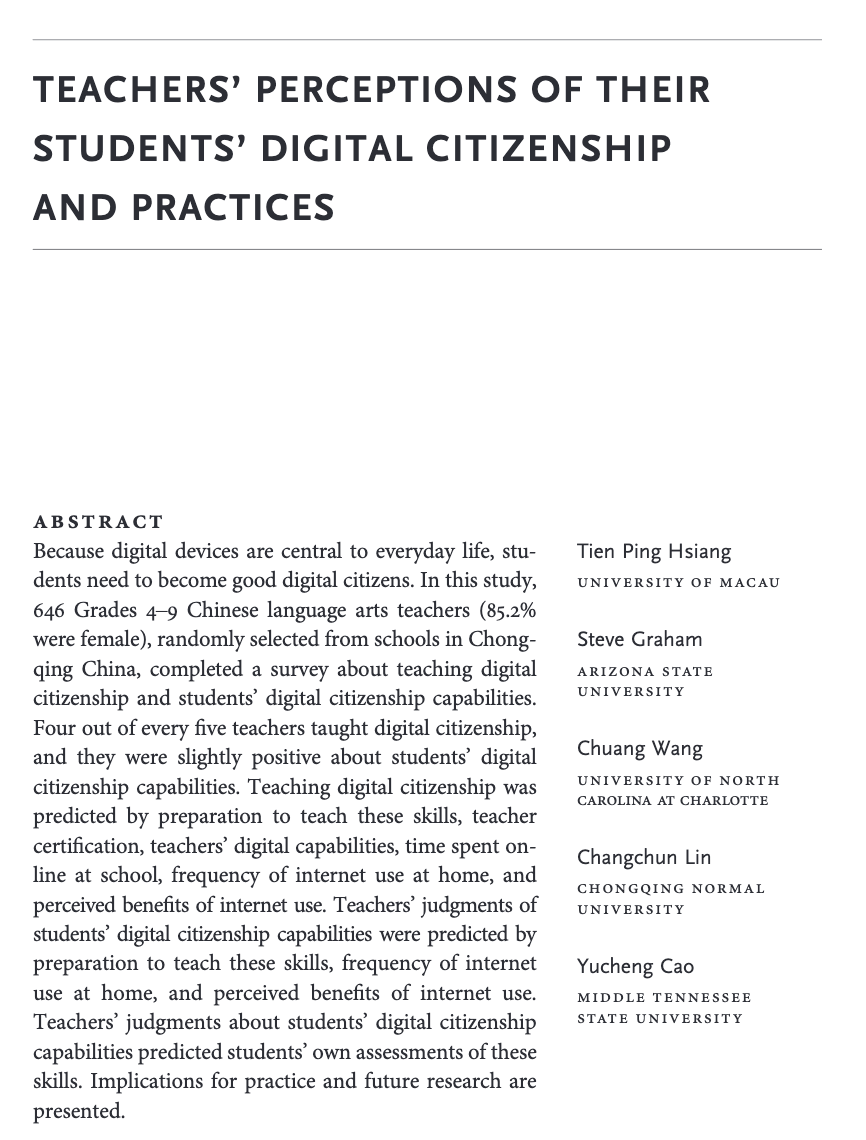
Because digital devices are central to everyday life, students need to become good digital citizens. In this study, 646 Grades 4–9 Chinese language arts teachers (85.2% were female), randomly selected from schools in Chongqing China, completed a survey about teaching digital citizenship and students’ digital citizenship capabilities. Four out of every five teachers taught digital citizenship, and they were slightly positive about students’ digital
citizenship capabilities. Teaching digital citizenship was predicted by preparation to teach these skills, teacher certification, teachers’ digital capabilities, time spent online at school, frequency of internet use at home, and perceived benefits of internet use. Teachers’ judgments of students’ digital citizenship capabilities were predicted by preparation to teach these skills, frequency of internet use at home, and perceived benefits of internet use.
Teachers’ judgments about students’ digital citizenship capabilities predicted students’ own assessments of these skills. Implications for practice and future research are presented.
Contributions of this paper
The study of teachers’ perceptions of their students’ digital citizenship is limited to a study conducted in the U.S., which found that middle school teachers did not believe their students had developed good digital citizenship practices (Martin et al., 2019). More research attention has been devoted to asking students to rate their digital citizenship capabilities. Students generally agree they follow the social norms of digital citizenship, but this is not the case for all students and for all aspects of this construct (e.g., cyberbullying, sharing passwords with others, befriending strangers, and using false information to register online). No study to date has examined the relationship between teachers’ and students’ perceptions of students’ digital citizenship.
The present investigation expands on the Martin et al. (2019) study in six important ways. This is the only prior study examining teachers’ perceptions of students’ digital citizenship capabilities. First, the Grades 4 to 9 Chinese language arts teachers in this study were randomly selected from all of the public and private schools in the Chongqing municipality in China (Martin et al involved a convenience sample). Second, we asked teachers to assess their students’ capabilities by applying two additional aspects of digital citizenship: balanced media use and media literacy. Third, we established the factor structure and reliability of the various measures applied in this study. Martin et al. (2019) did not examine the psychometric properties of their instruments. Fourth, we applied a more expansive set of predictors to examine factors that accounted for the variance in teachers’ judgments about their students’ digital citizenship capabilities. This included teachers’ preparation to teach digital citizenship, how frequently teachers used digital devices for learning and recreation, and their beliefs about the benefits of online engagement. Fifth, we also examined factors that predicted reported teaching of digital citizenship by teachers (this was not done in Martin et al., 2019). This included the four constructs used to predict teachers’ beliefs about their students’ digital citizenship capabilities identified above as well as time spent online at school, teachers’ perceptions of their capabilities to use digital tools, and teacher certification.
The sixth way in which this study differed from Martin et al. (2019) is that we examined if teachers’ perceptions of students’ digital capabilities predicted students’ assessments of their own capabilities. We were unable to locate any study that had examined this issue previously. If teachers’ estimates are a strong predictor of students’ estimates of their digital citizenship capabilities, then this provides some empirical support for the use of teachers’ judgments as a means for determining what should be taught.
The present study found that most of the participating teachers taught digital citizenship to their students, and both teachers and students were positive about students’ digital citizenship capabilities. However, teachers’ judgements of students’ capabilities were not a strong predictor of students’ own estimates. Based on both teacher and students’ judgements, there is room for students to develop even stronger digital citizenship skills. Further, if teachers’ judgements are to serve formative assessment purposes, they need to be supplemented by other forms of evidence because the accuracy of teachers’ judgments of students’ digital citizenship skills are unknown.
Findings from this study are important because students need to learn how to act online in safe, responsible, healthy, and ethical ways. With the advent of artificial intelligence (AI), this has become even more critical. We think the concept of digital citizenship needs to be expanded to include AI (Hsiang et al., in press), and both parents, children, and teachers will need guidance on the kinds of socially desirable behaviors that children need to acquire in an AI world.
Journal
Elementary School Journal
The University of Chicago
ISSN: 0013-5984
E-ISSN: 1554-8279
5-year Journal Impact Factor: 1.5
2024 JCR Impact Factor*: 1.4
Ranked #326 out of 756 “Education & Educational Research” journals [Q2]
The Elementary School Journal has served researchers, teacher educators, and practitioners in the elementary and middle school education for more than one hundred years. ESJ publishes peer-reviewed articles that pertain to both education theory and research and their implications for teaching practice. In addition, ESJ presents articles that relate the latest research in child development, cognitive psychology, and sociology to school learning and teaching.
First published in 1900 as The Course of Study, the title was changed to The Elementary School Teacher and Course of Study in 1901. The title was changed to The Elementary School Teacher in 1902, and to The Elementary School Journal in 1914.
Link
https://doi.org/10.1086/736603
AERA i-Presentation Gallery: https://aera25-aera.ipostersessions.com/?s=2B-E7-94-D6-CF-4C-1A-00-B4-FC-06-E2-34-3B-84-CC